
Women Entrepreneurs in Canada: 15 Tax Planning Tips for Growing Businesses

Updated: 3 hours ago
Practical tax tips for women entrepreneurs in Canada, including self-employed professionals, freelancers, consultants, and incorporated business owners.
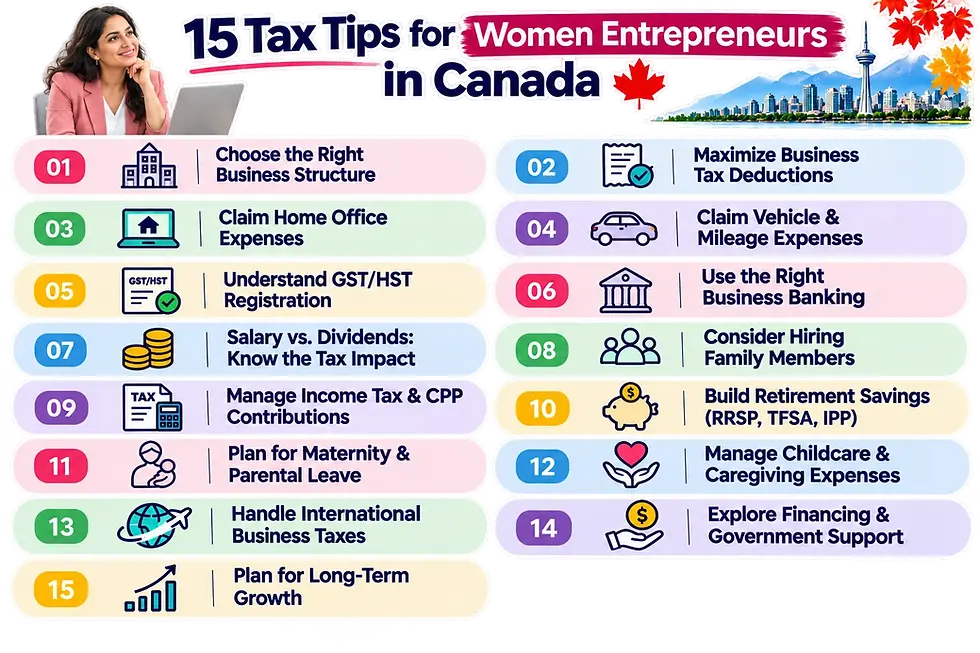
Building a successful business takes more than a great idea. For women entrepreneurs in Canada, managing taxes, protecting cash flow, and planning for long-term financial security are just as important as growing revenue.
Whether you're a freelancer, self-employed professional, consultant, or incorporated business owner, understanding Canadian tax rules can help you claim eligible deductions, avoid costly mistakes, and make informed financial decisions.
15 Practical Tax Tips for Women Entrepreneurs in Canada
Balancing business growth with family responsibilities, maternity leave, caregiving, or retirement planning can create additional financial challenges. These 15 practical tax tips for women entrepreneurs in Canada cover everything from business expenses and GST/HST to incorporation, retirement savings, and financing opportunities—helping you build a financially sustainable business.
1. Choose a Business Structure That Supports Your Growth
One of the first decisions entrepreneurs face is whether to operate as a sole proprietor or incorporate.
A sole proprietorship is generally simpler to establish and maintain. Business income and expenses are reported on the owner's personal income tax return.
A corporation is a separate legal entity that files its own corporate income tax return. Eligible Canadian-controlled private corporations may benefit from the small business deduction on qualifying active business income.
However, incorporation does not automatically mean paying less total tax.
Example: A freelance consultant earning $50,000 annually and withdrawing all her profits for personal living expenses may find sole proprietorship practical.
If her business grows substantially and she can retain earnings for future expansion, incorporation may provide tax-deferral and business-planning opportunities.
The appropriate structure depends on profitability, liability exposure, administrative costs, and long-term goals.
Tax planning tip: Reassess your business structure when your income increases, you begin hiring employees, or you plan to retain substantial profits.
2. Claim Eligible Business Expenses Without Overlooking Deductions
Business owners can generally deduct reasonable expenses incurred to earn business income, subject to CRA rules and limitations.
Common examples include:
Website hosting, online advertising, and marketing.
Accounting, bookkeeping, and legal fees.
Business software and cloud subscriptions.
Commercial rent and office supplies.
Business-related telephone and internet expenses.
Eligible professional development.
Business insurance.
Eligible travel and vehicle expenses.
Employee wages and subcontractor fees.
Some purchases, including equipment and furniture, may be capital assets rather than immediately deductible operating expenses.
Example: A self-employed designer generates $95,000 in annual revenue and incurs $25,000 in eligible deductible expenses.
Her net business income before other adjustments is $70,000.
Maintaining complete records helps ensure that legitimate deductions are not overlooked.
Tax planning tip: Review business expenses monthly instead of collecting receipts only when preparing your tax return.
3. Understand Home Office Expense Deductions
Many women entrepreneurs operate businesses from home, particularly in consulting, bookkeeping, education, design, and online services.
Eligible self-employed individuals may deduct a reasonable business portion of qualifying home expenses.
Depending on their circumstances, these may include:
Rent.
Electricity and heating.
Home insurance.
Eligible maintenance and repairs.
Certain other qualifying home expenses.
Eligibility generally requires the workspace to be the principal place of business or to be used exclusively to earn business income and regularly and continuously for meeting clients, customers, or patients.
For shared-use spaces, the calculation may need to account for both the area used and the time devoted to business activities.
Example: A business owner uses a 150-square-foot dedicated office in a 1,500-square-foot home.
The workspace represents 10% of the home's total area.
If qualifying annual home expenses are $18,000, the initial allocated amount may be $1,800, subject to eligibility and applicable restrictions.
Business-use-of-home expenses generally cannot create or increase a self-employment business loss.
Tax planning tip: Maintain records of workspace measurements, qualifying expenses, and how the space is used.
Related Resource – Home Office Expenses Calculator
Are you an employee working from home? Use CLaTAX's Home Office Expenses Calculator to estimate eligible employment-related home office expenses. Self-employed business owners follow different deduction rules.
4. Keep an Accurate Business Vehicle Mileage Log
If you drive to meet clients, deliver products, purchase business supplies, or travel between qualifying business locations, some vehicle expenses may be deductible.
When a vehicle is used for both personal and business purposes, the deductible portion generally depends on business kilometres compared with total kilometres driven.
Example:
Annual kilometres driven: 20,000
Qualifying business kilometres: 8,000
Business-use percentage: 40%
This percentage may help determine the deductible portion of eligible operating expenses, although separate rules apply to capital costs, leasing, and financing.
Ordinary personal commuting generally does not qualify as business travel.
Tax planning tip: Maintain a mileage log throughout the year recording the date, destination, business purpose, and kilometres travelled.
Calculate Your Business Mileage
Want to know what percentage of your vehicle use is business-related? Use CLaTAX's Vehicle Mileage Calculator to estimate your business-use percentage and support accurate expense tracking.
5. Monitor GST/HST Registration Requirements
As revenue grows, entrepreneurs may become required to register for GST/HST.
For most businesses making taxable supplies, the general small-supplier threshold is $30,000 in worldwide taxable revenues, measured under the applicable calendar-quarter rules.
Registration and collection obligations depend on when and how the threshold is exceeded.
Once registered, a business may be eligible to recover GST/HST paid on qualifying business purchases through input tax credits.
However, registration also creates invoicing, recordkeeping, and filing responsibilities.
Some businesses voluntarily register before reaching the mandatory threshold.
Tax planning tip: Monitor taxable revenues regularly and review registration requirements before crossing the threshold.
Make GST/HST Calculations Easier
Not sure how much GST/HST to charge on your sales or services? Use CLaTAX's GST/HST Calculator to calculate applicable sales tax and better understand the tax amounts involved in your business transactions.
6. Separate Business Finances From Personal Spending
Mixing household and business transactions can make bookkeeping difficult and create problems when preparing tax returns.
A separate business bank account helps entrepreneurs track revenue, identify expenses, reconcile transactions, and monitor cash flow.
For incorporated businesses, the distinction is particularly important because corporate funds belong to the corporation.
Personal withdrawals must be classified appropriately.
Depending on the circumstances, they may represent salary, dividends, shareholder loans, or repayment of amounts previously owed to the owner.
Tax planning tip: Maintain separate accounts and reconcile business transactions regularly.
7. Plan Your Salary and Dividends Carefully
Incorporated entrepreneurs often need to decide whether to compensate themselves through salary, dividends, or a combination.
Salary is generally deductible to the corporation when reasonable and properly paid. It also generally creates RRSP contribution room and attracts CPP contributions.
Dividends are not deductible to the corporation and generally do not create RRSP contribution room or attract CPP contributions.
Neither method is universally better.
The appropriate choice depends on personal income, corporate profitability, retirement goals, CPP considerations, and cash-flow needs.
Tax planning tip: Review owner compensation before year-end rather than making unplanned withdrawals throughout the year.
8. Understand the Rules for Employing Family Members
Family members sometimes contribute significantly to a growing business.
A spouse may manage administration, an adult child may assist with marketing, or another relative may provide bookkeeping or customer service.
Compensation for genuine business work may be deductible when it is reasonable, properly documented, and compliant with applicable rules.
Keep records of duties performed, hours worked, payment amounts, and payroll obligations.
Dividends paid to family members may be subject to Canada's tax on split income rules.
Tax planning tip: Treat family employment arrangements with the same documentation and compliance standards used for unrelated employees.
9. Set Aside Money for Income Tax and CPP
A business can be profitable on paper while lacking sufficient cash to meet its tax obligations.
Self-employed entrepreneurs generally need to plan for income tax and both the employee and employer portions of CPP contributions.
Depending on their circumstances, they may also need to make income tax instalments during the year.
Example: An entrepreneur earning $8,000 in monthly net business income could establish a separate tax reserve and transfer a portion of earnings into it regularly.
The appropriate amount depends on projected taxable income, province of residence, CPP obligations, deductions, credits, and other income.
A tax projection is more reliable than assuming one fixed percentage works for everyone.
Tax planning tip: Review projected income tax and CPP obligations quarterly, especially when profits increase.
10. Build Retirement Savings Alongside Your Business
Women entrepreneurs may experience periods of reduced income due to caregiving responsibilities, maternity leave, business interruptions, or career changes.
These interruptions can affect long-term retirement savings.
Tax planning should therefore consider both immediate business needs and future financial independence.
Possible strategies include:
Making RRSP contributions when appropriate.
Using available TFSA contribution room.
Planning salary and dividend payments with retirement goals in mind.
Maintaining emergency savings.
Reviewing corporate retained earnings and investment strategies.
Self-employment income and employment salary generally contribute to earned income used to determine RRSP contribution room, subject to the applicable rules.
Dividends do not create RRSP contribution room.
Tax planning tip: Include retirement planning in your annual business financial review rather than waiting until the business is fully established.
11. Plan for Maternity, Parental Leave, and Business Interruptions
For entrepreneurs planning to start or expand a family, maternity and parental leave may affect business income and operations.
Self-employed individuals may qualify for Employment Insurance special benefits if they voluntarily participate in the program and satisfy its conditions.
Eligibility is not automatic, and registration and contribution requirements apply.
Incorporated business owners may face different EI considerations depending on their employment relationship and share ownership.
Beyond government benefits, entrepreneurs should prepare for potential business interruptions by considering:
Emergency savings.
Temporary administrative support.
Client communication plans.
Recurring operating expenses.
Delegation of essential responsibilities.
Expected business income during leave.
Tax planning tip: Review maternity and parental benefit options well before a planned leave.
Know Your Maternity and Parental Benefit Options
Self-employed women may qualify for Employment Insurance (EI) special benefits, including maternity and parental benefits, if they voluntarily register and meet the program's eligibility requirements.
For eligibility conditions, registration details, and benefit information, visit Service Canada's EI Special Benefits for Self-Employed People.
12. Understand Childcare and Caregiving Tax Considerations
Many women entrepreneurs balance business responsibilities with childcare or support for aging family members.
These responsibilities may affect working hours, business growth, and household finances.
Eligible childcare expenses may qualify for a personal income tax deduction, subject to applicable conditions and limits.
However, ordinary childcare costs generally cannot be deducted as business operating expenses simply because they allow an entrepreneur to work.
Depending on individual circumstances, certain disability-related or caregiver tax measures may also be relevant.
Eligibility depends on the specific rules, including the circumstances of the person receiving care.
Tax planning tip: Review household tax deductions and credits separately from business expenses. Personal tax planning can be an important part of an entrepreneur's overall financial strategy.
13. Understand Taxes Before Expanding Internationally
Online businesses and professional service providers can attract customers outside Canada.
International expansion introduces tax considerations that may not arise when serving only Canadian customers.
These can include:
GST/HST treatment of cross-border services.
Foreign currency transactions.
Foreign withholding taxes.
Potential foreign tax credits.
Tax registration requirements in other jurisdictions.
International payment processing and bookkeeping.
For example, services supplied to non-resident clients are not automatically exempt from GST/HST. The applicable rules depend on the nature of the service and the circumstances.
Tax planning tip: Review cross-border tax obligations before international revenue becomes a significant part of your business.
14. Explore Business Financing and Women Entrepreneurship Programs
Access to financing can influence whether an entrepreneur can purchase equipment, hire employees, develop products, or expand into new markets.
Women entrepreneurs in Canada may be eligible for financing, mentorship, training, and networking programs.
The federal Women Entrepreneurship Strategy is one resource worth exploring.
Provincial programs, financial institutions, and business development organizations may also provide relevant support.
Program eligibility, funding availability, and application requirements can change.
It is also important to understand the tax treatment of funding.
Business loan proceeds are generally not taxable revenue when received, while repayment of loan principal is generally not deductible. Interest may qualify for a deduction when the applicable conditions are met.
Grants and other financial assistance can have different tax consequences.
Tax planning tip: Review financing options and their tax implications before committing to major expansion costs.
Explore Government Support for Women-Owned Businesses
The Government of Canada's Women Entrepreneurship Strategy supports women entrepreneurs through access to financing, business networks, mentorship, and growth opportunities.
Explore the official Women Entrepreneurship Strategy to learn about available programs and participating organizations.
15. Make Tax Planning Part of Every Major Business Decision
Tax planning should not begin when the annual return is due.
Important decisions throughout the year can affect taxable income, cash flow, and future obligations.
These include:
Incorporating a business.
Hiring employees.
Purchasing equipment.
Opening another location.
Bringing in a business partner.
Changing owner compensation.
Expanding internationally.
Selling a business or planning succession.
For example, purchasing equipment shortly before year-end may affect capital cost allowance claims, depending on the applicable rules and when the asset becomes available for use.
Similarly, hiring employees introduces payroll deductions, employer contributions, reporting requirements, and employment standards obligations.
Tax planning tip: Review the financial and tax consequences before making significant business decisions.
Common Tax Mistakes Women Entrepreneurs Should Avoid
Even experienced entrepreneurs can make costly tax mistakes.
Some of the most common include:
Mixing personal and business expenses.
Missing GST/HST registration deadlines.
Claiming personal purchases as business deductions.
Failing to budget for income tax and CPP.
Making undocumented shareholder withdrawals.
Assuming incorporation always reduces total taxes.
Overlooking eligible business expenses.
Neglecting retirement planning.
Waiting until tax filing season to review financial records.
Regular bookkeeping, tax projections, and professional advice can help prevent these problems.
A Practical Tax Planning Checklist
Before the end of each quarter, consider reviewing the following:
Reconcile business bank and credit card accounts.
Review business expenses and missing receipts.
Update home office and vehicle mileage records.
Check GST/HST registration and filing obligations.
Estimate income tax and CPP liabilities.
Review salary, dividends, and shareholder loan balances.
Check payroll compliance requirements.
Review RRSP contributions and retirement goals.
Update business cash-flow projections.
Identify upcoming purchases or expansion decisions requiring tax advice.
A regular review can help entrepreneurs identify potential problems before they become expensive.
Frequently Asked Questions
Do women entrepreneurs receive special tax deductions in Canada?
Canadian business tax deductions generally depend on the type of expense, business activity, and taxpayer's circumstances rather than gender. However, women entrepreneurs may qualify for targeted financing, mentorship, and business development programs.
Is incorporation better than self-employment?
Not necessarily. Incorporation can offer advantages in certain circumstances, particularly when business profits can be retained for future investment. However, it also creates additional administrative, accounting, and compliance obligations.
Can a self-employed mother deduct childcare expenses?
Eligible childcare expenses may qualify for a personal income tax deduction, subject to CRA requirements. They generally are not ordinary business operating expenses.
Can I claim home office expenses if I work from home?
Potentially. Eligibility depends on how the workspace is used and whether the applicable CRA conditions are satisfied.
Can women entrepreneurs deduct makeup and professional clothing?
Ordinary makeup, grooming, and everyday clothing are generally personal expenses and not deductible simply because professional appearance is important to the business. Special circumstances may require separate analysis.
How often should business owners review their taxes?
A quarterly financial and tax review is a useful practice. More frequent reviews may be appropriate when revenue changes significantly, a business hires employees, or major financial decisions are planned.
How CLaTAX Helps Women Entrepreneurs Across Canada
At Cloud Accounting & Tax Services Inc. (CLaTAX), we understand that managing a business involves more than increasing sales. Entrepreneurs also need reliable financial records, tax compliance, and practical planning to support long-term growth.
We assist self-employed individuals, freelancers, consultants, professionals, and incorporated business owners with:
Personal income tax returns (T1).
Self-employment income and expense reporting.
Corporate income tax returns (T2).
Bookkeeping and financial statement preparation.
GST/HST registration, returns, and compliance.
Payroll administration and employee reporting.
Business expense reviews.
CRA correspondence and tax-related inquiries.
Based in Metro Vancouver, CLaTAX provides remote accounting and tax services to clients across supported Canadian provinces.
Growing your business is an achievement. Protecting its financial future requires planning.
Whether you are starting a new venture, expanding an established business, or reviewing your current tax strategy, professional guidance can help you make informed decisions.
Explore our services: https://www.claccounting-tax.ca/services
Disclaimer: This article provides general Canadian tax information and is intended as an educational resource. Tax laws, contribution limits, program availability, and individual circumstances may change. Consult a qualified tax professional before making significant tax or financial decisions.


Comments