
Canada Federal Budget 2026: Tax Changes for Individuals, Self-Employed Canadians and Families

Updated: 6 days ago
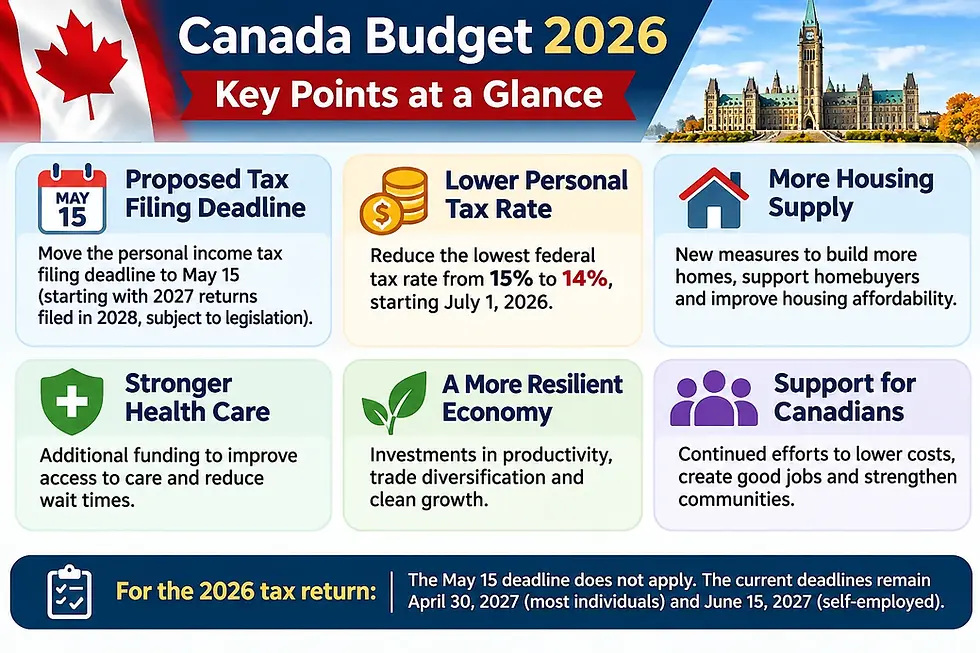
Canada Federal Budget 2026: Personal Tax Changes & Key Highlights
Canada's federal government released Budget 2026, Masters of Our Destiny, on November 5, 2026, outlining proposed tax changes affecting individuals, families, employees, freelancers, self-employed professionals, seniors, caregivers and investors.
The Canada Federal Budget 2026 tax proposals include a May 15 personal income tax filing deadline, higher income tax instalment thresholds, simplified foreign property reporting, a refundable caregiver tax credit and additional financial support for eligible households.
Important: Budget announcements do not automatically become law. The proposed measures discussed below remain subject to parliamentary approval and implementing legislation.
1. Canada Budget 2026: Proposed May 15 Tax Filing Deadline
Canada's Federal Budget 2026 proposes establishing May 15 as the common personal income tax filing and payment deadline for individuals, including self-employed taxpayers and their spouses or common-law partners.
Current vs. Proposed Filing Deadlines
When Would the New Deadline Take Effect?
The proposed change would apply beginning with the 2027 taxation year, meaning the first affected personal income tax returns would be filed in 2028.
For the 2026 taxation year (returns filed in 2027), the existing deadlines would remain unchanged:
April 30, 2027: Filing deadline for most individuals and payment deadline for personal income tax balances.
June 15, 2027: Filing deadline for self-employed individuals and their spouses or common-law partners.
What Does This Mean for Individuals and Self-Employed Canadians?
For Individuals & Families:
Under the proposal, most individuals would have approximately 15 additional days to file their personal income tax returns and pay any outstanding tax balances, as the deadline would move from April 30 to May 15.
For Self-Employed Canadians:
Self-employed individuals and their spouses or common-law partners would have approximately one month less to file their income tax returns, as the filing deadline would move from June 15 to May 15.
However, their tax payment deadline would be extended by approximately 15 days, from April 30 to May 15, aligning the filing and payment deadlines.
Effective Date: These proposed changes would first apply to the 2027 taxation year (returns filed in 2028), subject to legislative approval.
2. Canada Budget 2026: Higher Income Tax Instalment Thresholds
Budget 2026 proposes increasing the federal income tax instalment threshold from $3,000 to $7,500 for individuals outside Quebec, starting in 2028.
This change would benefit eligible employees, retirees, investors and self-employed Canadians, meaning fewer taxpayers may need to make quarterly instalment payments.
For Quebec residents, the proposed federal threshold is $4,500.
Special Option for Self-Employed Canadians
Qualifying self-employed individuals could make one annual instalment payment instead of four quarterly payments.
Effective Date: 2028 taxation year, subject to legislative approval.
How Could Higher Instalment Thresholds Help Taxpayers?
Under the proposed rules, eligible taxpayers outside Quebec whose net tax owing falls below the new $7,500 threshold may no longer be required to make income tax instalment payments, provided they do not otherwise meet the applicable instalment requirements.
This could benefit self-employed professionals, freelancers, contractors, retirees and investors who currently make quarterly instalment payments.
Example: A self-employed consultant with $5,000 in net tax owing may be required to make instalments under the existing $3,000 threshold, depending on their prior-year tax balances. Under the proposed $7,500 threshold, that taxpayer may no longer need to make instalments.
Important: The proposal does not eliminate income tax liability. Eligible taxpayers would still need to pay their outstanding tax balances by the applicable payment deadline.
3. Canada Budget 2026: T1135 Foreign Property Reporting Threshold Increased to $200,000
Canada's Federal Budget 2026 proposes increasing the Form T1135 (Foreign Income Verification Statement) reporting threshold from $100,000 to $200,000, potentially reducing foreign asset reporting requirements for eligible Canadian taxpayers.
The simplified reporting threshold would also increase from $250,000 to $500,000.
These thresholds are generally based on the cost amount of specified foreign property, which may include:
Foreign bank accounts.
Shares of foreign corporations, including certain U.S. stocks.
Investment properties located outside Canada.
Other specified foreign investments.
Example: A Canadian resident holding specified foreign property with a total cost amount of $150,000 may currently be required to file Form T1135. Under the proposed $200,000 threshold, that taxpayer may no longer be required to file the form, assuming the relevant conditions are met.
Important: Foreign income, including interest, dividends, rental income and capital gains, must still be reported on Canadian income tax returns when applicable, even if Form T1135 is not required.
Proposed Effective Date: Taxation years or fiscal periods ending after 2026, subject to legislative approval.
4. Canada Caregiver Credit: Proposed Refundable Benefit
The federal government proposes making the Canada Caregiver Credit fully refundable, beginning in 2027.
Eligible caregivers could receive up to $1,260 for 2027, indexed in subsequent years.
This change could help qualifying caregivers who support family members with physical or mental impairments, including caregivers with little or no income tax payable.
Eligibility, supporting documentation and the final credit calculation would remain subject to applicable tax rules.
5. Canada Groceries and Essentials Benefit
Budget 2026 proposes a one-time 50% extra payment to help eligible Canadians manage rising grocery and living costs.
The additional payment, expected in early 2027, could provide:
Up to $339 for an eligible single individual without children.
Up to $679 for an eligible couple with two children.
The actual amount depends on family income and household circumstances.
Important: Eligible Canadians should file their income tax returns every year to continue receiving income-tested benefits.
Expected Payment: Early 2027, subject to legislative approval.
6. Build Canada Workers Benefit 2027: Eligibility, Amounts and Proposed Changes
Canada's Federal Budget 2026 proposes introducing the Build Canada Workers Benefit (BCWB), an enhanced refundable tax credit designed to provide additional financial support to low- and modest-income working Canadians.
The proposed benefit would replace and enhance the existing Canada Workers Benefit (CWB), beginning with the 2027 taxation year.
Who May Qualify for the Build Canada Workers Benefit?
Eligible individuals may include:
Low-income employees working full-time or part-time.
Self-employed Canadians earning qualifying business income.
Freelancers and gig workers, including eligible delivery drivers, rideshare drivers and independent contractors.
Single parents and working families with low or modest incomes.
Eligible workers with disabilities, who may also qualify for an additional disability supplement.
Eligibility would depend on working income, adjusted family net income, age, residency, family circumstances and other applicable conditions.
Full-time students generally face additional eligibility restrictions, subject to exceptions.
Proposed Build Canada Workers Benefit Amounts for 2027
Budget 2026 also proposes reducing the minimum working-income threshold from $3,000 to $500, potentially allowing more very-low-income workers to qualify.
For the disability supplement, the proposed minimum earnings threshold would decrease from $1,150 to $200.
7. Simplified Moving and Other Personal Expense Claims
Budget 2026 proposes introducing optional flat-rate deductions and tax credits for certain personal expenses, making it easier for eligible Canadians to claim tax relief without calculating and itemizing every expense.
The proposed measures cover moving expenses, employment-related deductions, tradespeople's labour mobility expenses, home accessibility improvements, adoption expenses and selected medical expenses.
Example 1: Employee Relocating for Work
An employee who moves to another city for a new job and meets the eligibility requirements for moving expenses could choose a $1,000 flat moving expense deduction instead of calculating actual eligible expenses.
For example, an eligible employee with $700 in actual moving expenses could potentially claim the proposed $1,000 flat deduction.
However, if actual eligible moving expenses total $3,500, claiming those expenses may provide a larger deduction.
The deduction remains subject to applicable income limits and other eligibility requirements.
Example 2: Self-Employed Consultant Relocating for Business
A self-employed consultant who relocates to establish or operate a business in another city may qualify for the moving expense deduction if the relocation meets the applicable requirements.
Under the proposal, the consultant could choose the $1,000 flat deduction instead of itemizing eligible moving expenses.
For example, a qualifying consultant with $800 in actual moving expenses could potentially deduct $1,000, subject to the applicable income limit.
Important: This proposed flat-rate option applies to eligible moving expenses. It does not replace the existing rules for ordinary self-employment business expenses such as vehicle costs, home office expenses, advertising, professional fees or business supplies.
Example 3: Construction Workers and Apprentices
Eligible construction tradespeople and apprentices who temporarily relocate for work could choose a proposed $1,500 annual flat deduction instead of claiming actual eligible temporary relocation expenses.
The existing eligibility requirements would continue to apply.
Other Proposed Simplified Claims
Budget 2026 also proposes optional flat amounts for certain qualifying home accessibility expenses, adoption expenses and selected medical expenses.
Important: Flat-rate options would not automatically apply to every taxpayer. Individuals must still satisfy the applicable eligibility requirements.
Proposed Effective Date: Generally the 2027 taxation year and subsequent years, subject to legislative approval. Some measures have different proposed effective dates.
8. RRSP and RRIF: Potential Retirement Rule Changes
Budget 2026 announces consultations on a possible RRSP-for-life system.
Currently, individuals generally must mature their RRSPs by the end of the year they turn 71, commonly by converting them to RRIFs or purchasing qualifying annuities.
The government is considering reforms that could simplify retirement savings arrangements.
For a better understanding of RRSP contribution limits, tax deductions and retirement savings strategies, explore our RRSP Tax Planning in Canada: How to Reduce Your Tax Bill Legally.
Important: No change to the existing RRSP conversion requirement has been enacted through this consultation announcement.
9. Investors and Capital Gains
Budget 2026 proposes a Canada Growth Incentive that could provide an exemption for up to $15 million in capital gains from qualifying investments in eligible Canadian corporations.
The proposal is subject to specific eligibility requirements, including conditions concerning qualifying shares and investors.
This incentive is separate from the existing Lifetime Capital Gains Exemption.
For a better understanding of capital gains tax rates, inclusion rules, exemptions and tax-saving strategies, explore our Capital Gains Tax in Canada: Rates, Rules and Smart Tax-Saving Strategies.
Individuals investing in private Canadian businesses should review the final legislation before relying on the proposed exemption.
10. CRA Objections and Taxpayer Rights
Budget 2026 proposes giving Canadians more time to dispute a CRA income tax assessment or reassessment.
The standard Notice of Objection deadline would increase from 90 days to one year.
For individuals, the proposed deadline would generally be the later of:
One year after the CRA sends the assessment.
Two years after the tax return filing deadline for the taxation year.
However, the proposal would also eliminate the option to request an extension after the applicable objection deadline.
Important: Until the new rules become law and take effect, taxpayers must follow the existing CRA objection deadlines.
11. What About the 2026 Tax Return?
The proposed May 15 filing deadline does not apply to 2026 income tax returns filed in 2027.
The existing deadlines remain:
April 30, 2027: Filing deadline for most individuals and payment deadline for personal income tax balances.
June 15, 2027: Filing deadline for self-employed individuals and their spouses or common-law partners.
Self-employed Canadians should maintain accurate records of business income, expenses, vehicle mileage, home office costs, capital purchases and GST/HST transactions.
Important: The proposed May 15 deadline would first apply to 2027 tax returns filed in 2028, subject to legislative approval.
Frequently Asked Questions
Has the personal income tax deadline changed to May 15?
Not yet. The federal government proposes the change beginning with the 2027 taxation year.
Will self-employed individuals still have until June 15?
Under the proposed system, the common filing deadline would become May 15.
Is the T1135 threshold now $200,000?
The increase is proposed for taxation years or fiscal periods ending after 2026, subject to legislation.
Will every caregiver receive $1,260?
No. The proposed amount is a maximum and depends on eligibility.
Has the RRSP conversion age changed?
No. The government has announced consultations, not an enacted change.
Official Sources
Disclaimer: This article summarizes selected federal budget proposals as announced November 5, 2026. Proposed tax measures are subject to legislative approval and may change. Individual circumstances and applicable law determine tax obligations and benefits.


Comments