
New Year, New Benefits: 2026 Canada Benefit Increases and Key Changes
- Anamika Biswas

- Dec 22, 2025
- 5 min read
Updated: Dec 23, 2025
As we step into a new year, many Canadians are asking an important question:
“Will government benefits increase in 2026?”
The answer is yes.
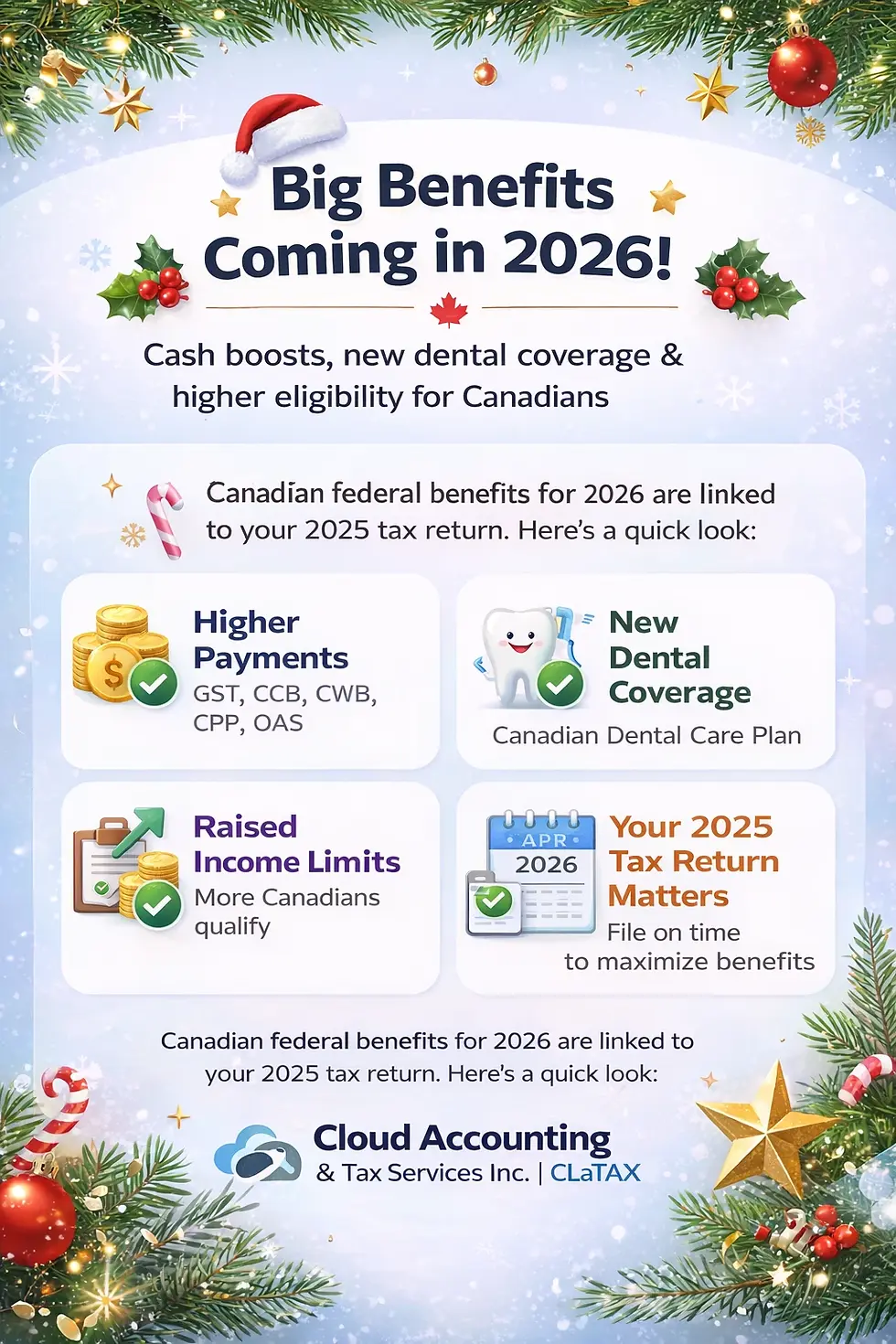
To help Canadians manage rising living costs, the federal government has confirmed inflation-based increases to major benefits for 2026. These changes will affect families, workers, seniors, and people with disabilities—and in many cases, income thresholds are also increasing, allowing more people to qualify.
Here’s what you need to know as you plan your finances for the year ahead.
Table of Contents
• Why Canada Benefits Are Increasing in 2026
• Key Federal Benefit Increases Canadians Can Expect in 2026
• NEW: Canadian Dental Care Plan (CDCP)
• How Much Will the CDCP Pay?
• Key Tax Changes to Be Aware of in 2026
• Why Your 2025 Tax Return Is Critical
• How Cloud Accounting & Tax Services Inc. | CLaTAX Can Help
• Frequently Asked Questions (FAQ)
• References
Why Canada Benefits Are Increasing in 2026
Each year, the Canada Revenue Agency (CRA) and Service Canada adjust benefit amounts based on inflation. For the 2026–27 benefit year, most programs are increasing by approximately 2%, with some tied directly to tax-year inflation.
These adjustments are designed to:
Offset higher living costs
Preserve purchasing power
Expand eligibility through higher income thresholds
Key Federal Benefit Increases Canadians Can Expect in 2026
🇨🇦 GST/HST Credit (Quarterly Payments)
The GST/HST Credit supports low- and modest-income Canadians with the cost of everyday purchases.
What’s changing in 2026:
Single adults: up to $543 annually
Couples: up to $712
Per child: $187
Family of four: up to $1,086 per year
Income threshold: Phase-out begins at $46,432 (family net income)
When payments increase: 📅 July 2026
👷 Canada Workers Benefit (CWB)
The CWB is a refundable tax credit for lower-income workers, including a disability supplement.
2026 maximum amounts (based on 2025 tax return):
Single workers: up to $1,633
Families: up to $2,813
Disability supplement: up to $843 per person
Income phase-out starts at:
$26,855 (single)
$30,639 (families)
Advance payments: Half of the benefit is paid automatically in July, October, and January.
👶 Canada Child Benefit (CCB)
The CCB remains one of the most valuable tax-free benefits for Canadian families.
Starting July 2026:
Children under 6: $8,157 per year ($679.75/month)
Children aged 6–17: $6,883 per year ($573.58/month)
Income thresholds:
First reduction begins at $38,237
Second reduction begins at $82,847
Income reductions begin at: $38,237
♿ Child Disability Benefit (CDB Supplement)
Families caring for a child with a severe and prolonged disability will see a modest increase.
2026 maximum:
$3,480 per child per year
$290 per month
The income phase-out begins at $82,847.
New amounts appear with the July 2026 CCB payment.
🧑🦽 Canada Disability Benefit (Adults 18–64)
Introduced in 2025, this benefit supports working-age adults approved for the Disability Tax Credit.
While final 2026 rates are not yet confirmed, inflation indexing suggests:
Estimated $2,448 per year
About $204 per month
Updated payments are expected to begin July 2026.
👵 Canada Pension Plan (CPP) & Old Age Security (OAS)
CPP (January 2026):
Estimated retirement maximum: ~$1,461 per month
Disability and survivor benefits also increase by ~2%
OAS (January–March 2026):
Ages 65–74: ~$742 per month
Ages 75+: ~$816 per month
OAS clawback starts at $93,454 (based on 2025 income)
NEW for 2026: Canadian Dental Care Plan (CDCP)
Dental care is now part of Canada’s federal benefit system through the Canadian Dental Care Plan (CDCP). This program is designed to help eligible Canadians who do not have private dental insurance access essential oral health services.
The CDCP focuses on improving affordability and access to basic dental care, particularly for individuals and families with lower or moderate incomes. Coverage is income-tested and administered directly through the federal government, with services provided by participating dental professionals.
Depending on eligibility, the plan may help cover services such as routine exams, cleanings, X-rays, and other essential treatments, reducing out-of-pocket dental costs for qualifying Canadians.
Who May Qualify
You may be eligible if you:
Are a Canadian resident for tax purposes
Have filed your previous year’s tax return
Do not have private dental insurance
Have adjusted family net income under $90,000
How Much Will the CDCP Pay?
Coverage depends on your adjusted family net income, as determined by the CRA.
Important CRA clarification: CDCP coverage applies only to eligible dental services at CDCP fee schedule rates. If a dental provider charges more than the CDCP rate, patients may need to pay the difference. Eligibility also requires that you do not have private dental insurance and that your tax return is filed.
Key Tax Changes to Be Aware of in 2026
Beyond benefit increases, several important tax changes in 2026 may affect your take-home pay—even if your salary remains unchanged. To understand how these updates work together, review our guide on Canada Tax Changes 2026.
✅ Federal tax brackets and credits are indexed for inflation, allowing you to earn more before moving into a higher bracket
✅ CPP contribution maximums increase, which may slightly reduce net pay for higher earners
✅ Old Age Security (OAS) continues quarterly inflation adjustments
✅ TFSA contribution room for 2026 is $7,000, creating additional tax-free savings opportunities
✅ Payroll deductions may change, even if your salary stays the same
✅ Indexation helps prevent “bracket creep”, protecting income from inflation-only tax increases
Why Your 2025 Tax Return Is Critical
Most 2026 benefits — including cash payments and dental coverage — are calculated using your 2025 tax return.
If your return is:
Filed late
Missing income
Incorrect
You may experience delayed benefits, reduced payments, or coverage gaps.
How Cloud Accounting & Tax Services Inc. | CLaTAX Can Help
At Cloud Accounting & Tax Services Inc. | CLaTAX, we help individuals and families navigate benefit changes and tax updates with confidence. With higher government benefits, new dental support, and updated tax rules coming into effect in 2026, our goal is to ensure you receive every dollar you’re entitled to while avoiding unnecessary delays or clawbacks.
We assist clients with:
Filing accurate and timely tax returns
Maximizing government benefits and credits
Confirming eligibility for the Canadian Dental Care Plan (CDCP)
Reducing benefit clawbacks through proper tax planning
Assisting seniors with CPP and Old Age Security (OAS) planning
The holiday season is a time for peace of mind, and good tax planning plays an important role in that. With the right guidance, 2026 can offer meaningful financial opportunities for many Canadian households.
If you’re unsure how these changes apply to you or your family, professional support can make all the difference.
🎄 From all of us at Cloud Accounting & Tax Services Inc. | CLaTAX, Merry Christmas and Happy New Year!
Frequently Asked Questions (FAQ)
Do I need to apply for the 2026 benefit increases?
No. Most benefits such as the CCB, GST/HST Credit, and CWB adjust automatically if your tax return is filed on time. Dental coverage under the CDCP requires a separate application.
Is dental coverage automatic under the Canadian Dental Care Plan?
No. Eligible Canadians must apply for the CDCP and must not have private dental insurance. Coverage is based on income reported to the CRA.
What happens if I file my tax return late?
Late filing may result in delayed benefit payments, reduced eligibility, or temporary loss of dental coverage until your return is processed.
Are CPP and OAS affected by my tax return?
CPP is contribution-based, but OAS clawback and eligibility thresholds depend on reported income, making accurate filing essential.
Can I qualify for benefits if my income did not change?
Yes. Because income thresholds increase with inflation, some Canadians may qualify for higher benefits even if income stays the same.
References
Information in this article is based on publicly available federal benefit updates, Canada Revenue Agency (CRA) guidance, and official Government of Canada announcements related to the 2026 benefit year. Benefit amounts, eligibility criteria, and income thresholds are subject to change based on final government confirmation and individual tax circumstances.


Comments